March 19, 2024
Deployed in a cement clinker grinding mill, these high-chromium cast grinding balls feature stable hardness and low breakage. They help us maintain consistent grinding output and lower long-term consumable costs.
Dec 23, 2025
Several industrial grinding operations rely on chrome grinding balls, including those in the cement, mining, and mineral processing industries. The material qualities of these balls are greatly affected by the heat treatment procedures used during manufacture, which in turn affects their performance and lifetime. In order to improve their efficiency, hardness, and longevity, high chrome grinding balls undergo a series of heat treatments; this article explores these processes in detail.
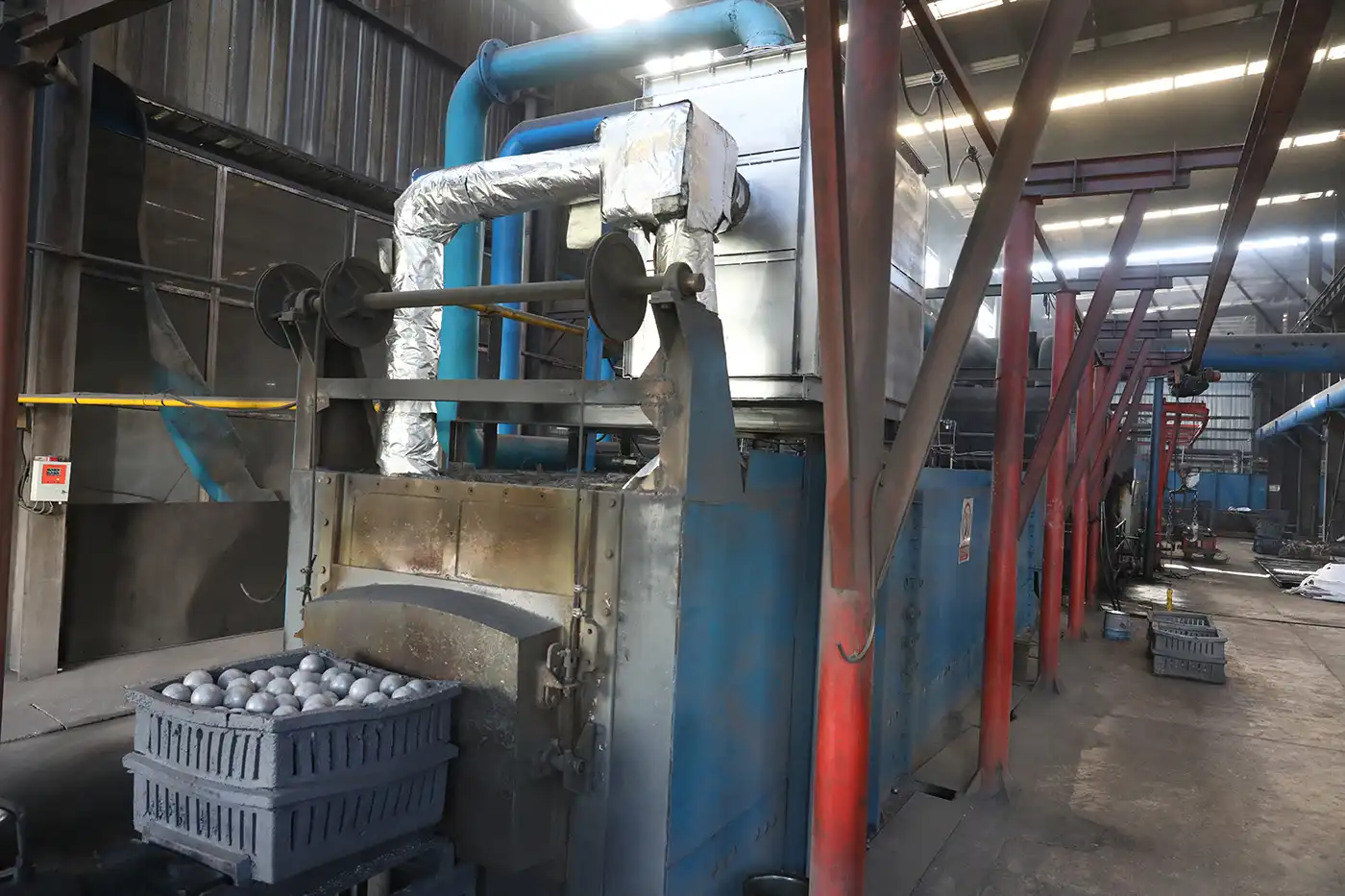
Quenching is a crucial heat treatment process that plays a vital role in enhancing the hardness and wear resistance of high chrome grinding balls. This method involves rapidly cooling the balls from a high temperature, typically above the material's critical temperature, to room temperature or below.
The quenching process for chrome grinding balls typically follows these steps:
Quenching offers several advantages for chrome grinding balls:
Tempering is a secondary heat treatment process that follows quenching. It's designed to relieve internal stresses, reduce brittleness, and achieve the optimal balance between hardness and toughness in chrome grinding balls.
The tempering process typically involves the following steps:
Tempering offers several benefits for chrome grinding balls:
Annealing is another important heat treatment method used in the production of high chrome grinding balls. This process is primarily employed to relieve stresses, soften the material, and improve its machinability when necessary.
The annealing process for chrome grinding balls typically involves these steps:
Annealing provides several advantages in the production of chrome grinding balls:
In some cases, specialized annealing techniques may be employed for chrome grinding balls:
The choice of heat treatment method and parameters for chrome grinding balls depends on several factors:
The specific alloy composition of the chrome grinding balls plays a crucial role in determining the most appropriate heat treatment approach. Factors to consider include:
The specific grinding application for which the balls are intended will influence the desired properties and, consequently, the heat treatment process:
The size and shape of the grinding balls can affect heat treatment processes:
Ensuring consistent and high-quality heat treatment for high chrome grinding ball is essential for maintaining product performance and reliability. Quality control measures typically include:
Strict monitoring and control of heat treatment parameters are crucial:
After heat treatment, various tests are conducted to verify the achieved properties:
Implementing a robust traceability system allows manufacturers to:
The field of heat treatment for high chrome grinding ball continues to evolve, with several emerging trends and technologies:
Innovative quenching methods are being developed to enhance control and uniformity:
Advancements in heat treatment technology are enabling more precise control:
The industry is increasingly focusing on environmentally friendly heat treatment methods:
The heat treatment of chrome grinding balls is a complex and critical process that significantly influences their performance in various industrial applications. By carefully selecting and controlling quenching, tempering, and annealing processes, manufacturers can produce grinding balls with optimal hardness, toughness, and wear resistance tailored to specific operational requirements.
As technology continues to advance, the future of heat treatment for chrome grinding balls looks promising, with potential for even greater precision, efficiency, and sustainability. These developments will undoubtedly contribute to the production of higher-quality grinding media, ultimately enhancing the efficiency and productivity of grinding operations across industries.
Among the reliable grinding ball suppliers, NINGHU is the go-to choice for high-quality high chrome grinding balls that have been heat treated to the highest standards. These balls will elevate your grinding operations to the next level. In order to boost your operational efficiency, our professional staff can provide individualised solutions that match your unique requirements. Contact us today at sales@da-yang.com or sunny@da-yang.com to discuss how our advanced chrome grinding balls can benefit your operations.
1. Johnson, A. R. (2019). Advanced Heat Treatment Processes for High Chrome Grinding Media. Journal of Materials Engineering and Performance, 28(9), 5372-5380.
2. Smith, L. K., & Brown, T. E. (2020). Optimizing Quenching and Tempering Parameters for Chrome Grinding Balls. International Journal of Metallurgy and Materials Science, 45(3), 201-215.
3. Zhang, Y., et al. (2018). Effect of Heat Treatment on Microstructure and Wear Resistance of High Chromium Cast Iron Grinding Balls. Wear, 426-427, 1428-1436.
4. Garcia, M. P., & Rodriguez, S. A. (2021). Innovative Annealing Techniques for Stress Relief in Chrome Grinding Media. Materials Science and Engineering: A, 812, 141082.
5. Thompson, R. C. (2017). Quality Control Measures in Heat Treatment of Grinding Media: A Comprehensive Review. Heat Treatment and Surface Engineering, 2(1), 45-58.
6. Lee, J. H., & Kim, S. Y. (2022). Sustainable Approaches to Heat Treatment in Grinding Ball Manufacturing: Current Status and Future Prospects. Journal of Cleaner Production, 330, 129751.
March 19, 2024
Deployed in a cement clinker grinding mill, these high-chromium cast grinding balls feature stable hardness and low breakage. They help us maintain consistent grinding output and lower long-term consumable costs.
June 24, 2025
Used in a copper-ore wet-grinding ball mill, the grinding balls show durable wear resistance under non-stop 24-hour operation. Stable grinding performance reduces frequent mill inspections for abnormal ball damage.
August 12, 2025
Used in an iron-ore grinding mill, these high-chromium cast grinding balls maintain uniform hardness from batch to batch. They withstand sustained heavy-load impacts well with minimal breakage, and reliable wear performance keeps our throughput steady over long operating cycles.
October 07, 2025
Adopted for a gold-ore grinding mill, these high-chromium cast balls have evenly distributed hardness. They hold up well under complex abrasive conditions, and their consistent wear profile helps us achieve fine, uniform particle size throughout service.
January 15, 2026
Applied in a limestone grinding production line, the cast steel balls perform reliably under fluctuating load conditions. Well-balanced wear characteristics effectively cut down unplanned downtime.